O'BRIEN | SiteArchitecture LLC Landscape Architecture Oklahoma City, Oklahoma
← Neighborhoods

The landscape professional your community has been missing.

Neighborhood Landscape Architect

Most HOAs and neighborhood associations spend real money on their landscape every year without professional guidance. The result is reactive decisions, contractor-driven priorities, and institutional knowledge that walks out the door every time the board changes.

O'BRIEN | SiteArchitecture fills the role no maintenance contractor fills — a licensed landscape architect who knows your site, carries the strategy forward, and gives your board the confidence to make good long-term decisions.

The Problem

Every year, without a plan.

Communities spend real money on their landscape year after year — replanting the same beds, reacting to what died, deferring to whichever contractor is cheapest or loudest. Without a professional holding the long view, that spending never compounds into anything.

Maintenance keeps a landscape alive. It does not make it better.

What It Looks Like
  • 01Annual color budgets spent on plants that disappear every fall, with nothing to show the following spring.
  • 02No long-term plan — decisions made reactively, one dead shrub at a time.
  • 03No standards to hand a new board member or a new contractor.
  • 04Contractor-driven priorities — the people paid to install are the ones deciding what gets installed.
  • 05Institutional knowledge lost with every board transition.
The Service Model

Three parts. One continuous relationship.

The service is built in three parts — a one-time assessment that establishes the foundation, an annual retainer that keeps a professional connected year-round, and phase design work scoped separately as your community is ready to build.

01 — Foundation

The Assessment

A one-time professional evaluation of your community's landscape — every public green space and planting bed assessed for condition, health, and priority. Delivered as a written report, a priority-classified plan, and a baseline masterplan that establishes design direction for everything that follows.

This is the foundation. Everything else builds on it.

One-Time Fixed Fee
02 — Ongoing

Annual Retainer

The ongoing professional relationship that keeps OBSA connected year-round. Annual site update in late summer or early fall — when plants have been through a full season and before your board's budget cycle closes. On-call advisory access for contractor review, plant questions, irrigation concerns, and board guidance. Institutional memory that carries forward regardless of who sits on the board next year.

Two tiers: advisory only, or advisory plus one design phase per year — the model Edinburgh has been operating on since 2023.

Annual Fee — Two Tiers Available
03 — Improvement

Phase Design Work

When your community is ready to move on an improvement — a bed renovation, an entry redesign, a new amenity area — that work is designed and coordinated as a dedicated phase. Design development from the approved masterplan into a full construction document set the contractor can bid and build from. Plant placement on site, pre-construction and closeout walkthroughs, contractor pricing review.

Each phase is sequenced from the assessment masterplan — so every improvement builds on the last, and the community sees visible, meaningful progress every year.

Per-Scope Agreement — Separate from Retainer
The Assessment

What you receive — and why it matters.

The assessment is not a proposal to sell you plants. It is an independent professional evaluation delivered by a licensed landscape architect who has no financial stake in what gets installed or who does the work.

It gives your board a foundation they can pass to the next board — and the board after that.

Core Assessment Deliverables
  • Written site assessment report — all public green spaces and planting beds evaluated for condition, plant health, gaps, and priority
  • Priority classification — each area assessed as high, medium, or low priority with supporting rationale
  • Site-scale plan on 36×48 board — priority areas highlighted, suitable for board presentation and clubhouse display
  • Phased improvement sequencing — priorities organized by condition severity and visual impact so your community sees meaningful progress with each phase
  • Baseline masterplan at SD/DD level — design intent document establishing the planting aesthetic and strategic direction for all future improvements
Optional Add-On Services
Existing Conditions Drawings
Measured plan drawings of major planting areas — a precise graphic record of what exists before any changes are made.
Tree Inventory
Catalog of all significant trees — species, size, condition, and professional recommendations. Valuable for communities with mature canopy or liability concerns.
Landscape Aesthetic Redevelopment
A deeper design exercise — reestablishing planting palette, character, and long-term aesthetic direction when the existing approach needs to be reconsidered from the ground up.
Annual Retainer

Two tiers. The right level of engagement for where your community is.

The retainer is an advisory relationship — not a maintenance contract, and not a license to call for anything at any hour. It defines what OBSA provides year-round, what is billed separately, and how the relationship works in practice.

Tier 1

Advisory Retainer

Professional advisory relationship — on-call access, annual site update, institutional memory. No design deliverables. Right for communities maintaining existing work or between active improvement phases.

Included Year-Round
  • Annual site update — one visit, written priority update, masterplan annotation (late summer / early fall)
  • On-call advisory access — board calls, contractor proposal review, plant questions, soil test interpretation
  • Institutional memory — OBSA maintains knowledge of the site, plan, and decisions across board transitions
  • Independent contractor review — OBSA has no financial stake in what gets recommended
  • Minor written guidance — email-level responses, not formal report deliverables
Requires Separate Scope
  • Design drawings or specifications
  • Construction documents or phase packages
  • Site visits beyond the annual update
  • Formal written reports

Additional advisory hours beyond the annual cap are billed at the standard hourly rate.

Tier 2

Advisory + Design Phase

Everything in Tier 1, plus one complete phased improvement scope per year — design through closeout. Right for communities actively implementing phases annually. This is the Edinburgh model.

Includes Everything in Tier 1, Plus:
  • One design phase per year — design development from the masterplan into planting plan and specifications
  • Construction documents for contractor — phase-specific CD set
  • Contractor pricing review — independent review of the contractor's bid against scope and plant list
  • Plant placement site visit — on-site coordination during installation
  • Pre-construction walkthrough — site conditions confirmed before contractor begins
  • Closeout walkthrough — installation verified against drawings, substitutions documented
  • Masterplan annotation — phase marked complete, priorities updated
  • Optional secondary walkthrough — late winter pre-season check-in before spring installation
Beyond Tier 2
  • Phases beyond one per year are scoped and billed separately
  • Phases significantly larger than a standard planting area are always scoped separately

Communities can move between Tier 1 and Tier 2 from year to year based on where they are in their improvement plan. There is no long-term commitment to either tier.

Annual Rhythm

Structured around Oklahoma's climate and your board's budget cycle.

The annual update happens when it is most useful — not on an arbitrary schedule.

Aug — Oct
Primary Site Update
Annual walkthrough after a full season of stress. Written priority update. Plan markup. Phase planning confirmed for the coming year.
Tier 1 + Tier 2
Oct — Dec
Board Budget Cycle
Assessment findings inform the board's landscape budget decisions. Phase scope for the following year is confirmed and scoped if proceeding.
Board-Side
Feb — Mar
Secondary Walkthrough
Light pre-season check-in. Spring phase readiness confirmed — contractor coordination, plant sourcing, site conditions. Available for Tier 2.
Tier 2 Add-On
Mar — Jun
Phase Installation
Spring installation window. Pre-construction walkthrough, plant placement on site, closeout. On-call available for contractor questions throughout.
Phase Work

Fall is also a strong planting window in Oklahoma — particularly for woody plants and perennials. When a community's phase is scheduled for fall installation, the pre-construction and closeout steps shift accordingly.

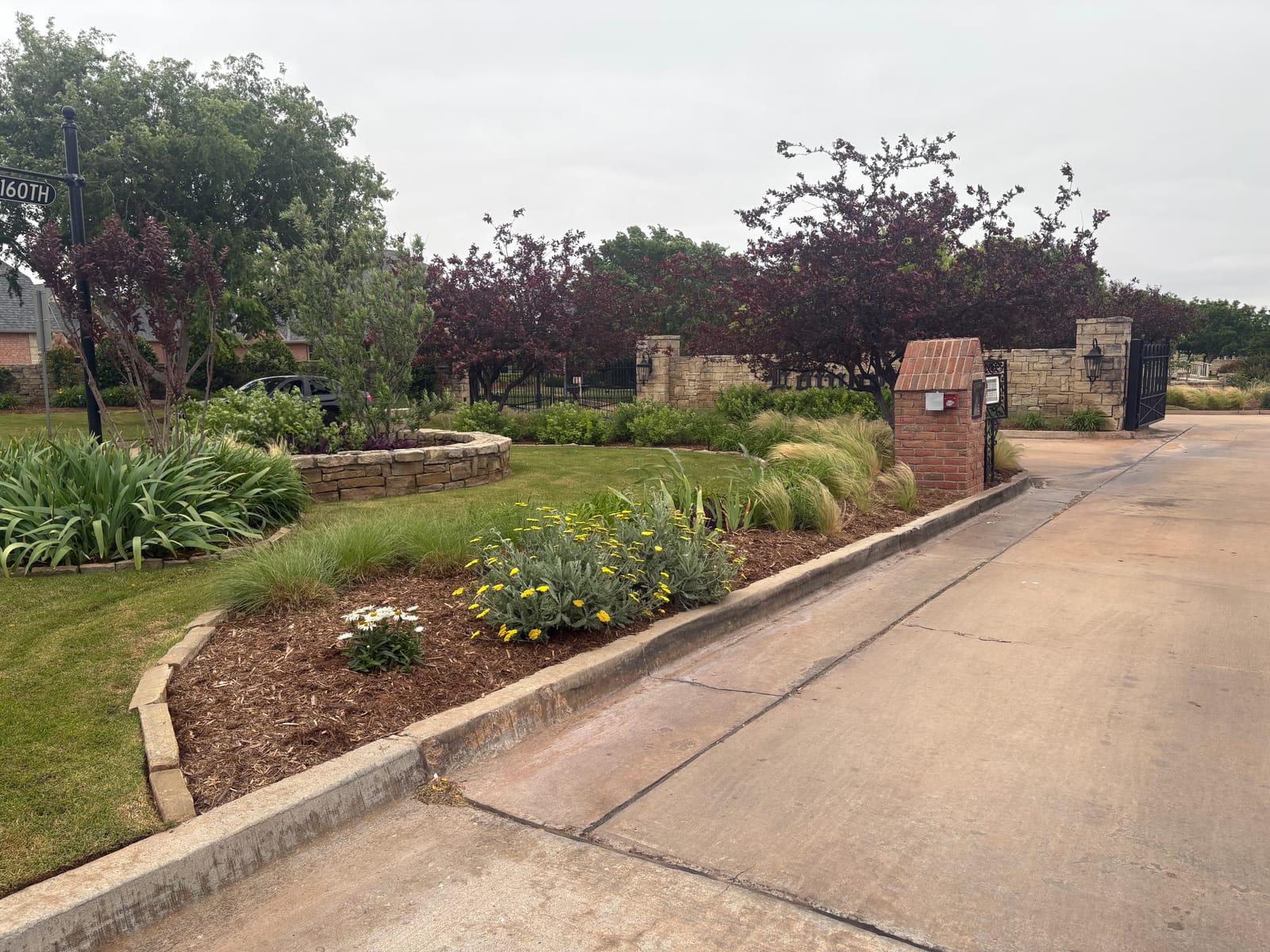
Edinburgh Home Association — neighborhood entrance planting
Featured Project

Edinburgh Home Association — Edmond

Edinburgh is a gated neighborhood built around a central green space one block wide and six blocks long. The community had been spending money every year replanting the same beds — no long-term plan, no standards to pass forward, no framework for deciding what to address first.

O'BRIEN | SiteArchitecture began with a full assessment. Three phases of landscape improvements are now installed. The annual color budget is being phased out. The board returns each year to plan the next phase — not because they have to, but because the process is working and the neighborhood is visibly improving.

22
Page site assessment and written report
17
Page existing plant species catalog
3
Phases of landscape improvements installed
Institutional knowledge that stays with the community
Read the Full Case Study →

Ready to talk about your community?

Whether your community is spending money every year without a plan, preparing for a major landscape investment, or simply trying to make better decisions with the budget you have — we would like to hear from you. The right place to start is a conversation.